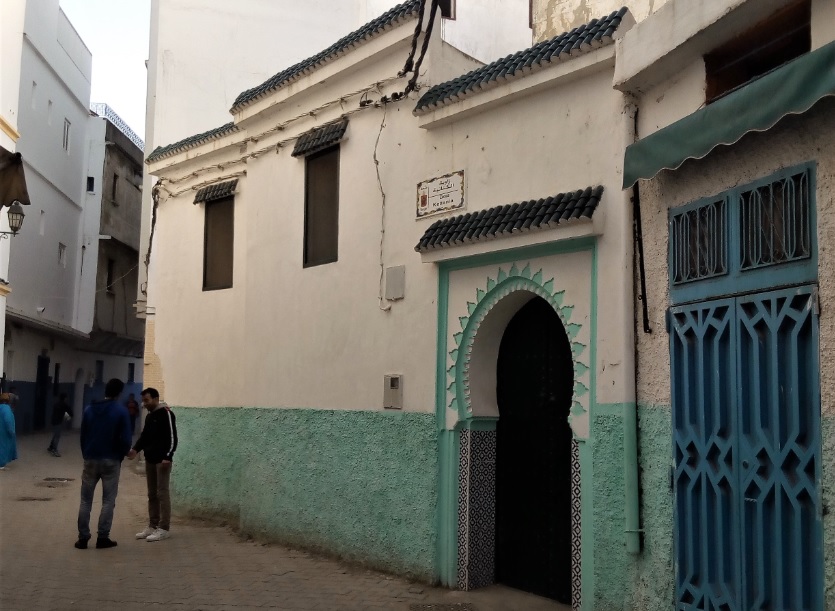
The Passing of a Man Whose Presence Remained
Reflections on the Life and Departure of Muhammad ibn Ja'far al-Kattani
There are men who live among people,
And there are men who live within them.
Imam Muhammad ibn Ja‘far al-Kattani was of the latter.
A man whose name was spoken not only with respect,
but with recognition.
Not recognition of position,
but of presence.
He was known in his time as a scholar,
a man of worship,
a servant of knowledge,
a guardian of conduct.
But those who knew him did not describe him by titles.
They described him by what he carried.
In the lands of al-Sham, they called him:
Sayyidunā as-Sayyid
Our Master, the Master.
Not as an exaggeration,
but as acknowledgment.
A man whose excellence was not debated,
whose knowledge was not contested,
whose conduct spoke before his words.
Those who came after him tried to compare him.
Some saw in him the echo of Muhammad ibn Idris al-Shafi'i—
an Imam for his time,
As al-Shafi‘i was for his.
But comparison, in such cases, is only a way of expressing awe.
And then came the moment that every life approaches, but not every life prepares for.
It was a night in Ramadan.
Quiet.
Measured.
As if time itself had slowed
to witness the departure.
He asked:
“What time is it?”
A simple question.
But not a simple moment.
He could no longer lift his hand.
The body had already begun its withdrawal.
Then came the words:
“Undo the collars… There is no time left.”
Not fear.
Not resistance.
Preparation.
And then, something else.
He began to welcome those who had passed before him.
Not in memory.
In presence.
“Welcome… welcome…”
Names spoken not as recollection, but as arrival.
As if the unseen had become visible to him.
As if the boundary had already dissolved.
At eleven o’clock that night, his soul returned.
Quietly.
Without struggle.
Like a breath released
after a long conversation.
But what followed did not belong to the night.
It belonged to the city.
Fez did not mourn him as a scholar.
Fez mourned him as one of its own essence.
The markets closed.
Not by decree.
By love.
The streets emptied,
not of grief,
but of movement,
As if the entire city had paused to accompany him.
They came in waves.
From Bab al-Futuh to Sab‘ Lwiyāt.
From rooftops to alleyways.
Men.
Women.
Children.
Not summoned.
Drawn.
They feared even the bier would not survive the love.
Hands reaching not to possess, but to touch.
To connect.
To receive something that words cannot carry.
And so, soldiers surrounded him.
Not to protect the dead.
But to protect the living
from their own longing.
They said one hundred thousand attended.
But numbers do not measure this.
Only hearts do.
He was buried.
And yet, he did not leave.
People continued to visit.
Not out of habit.
But out of recognition.
Something remained.
Something that did not dissolve with the body.
And when they opened his grave again,
fear entered the hearts of those present.
Not fear of death.
But fear of witnessing something beyond explanation.
They found him as he was.
Untouched.
Soft.
As if time had respected him.
As if the earth had refused to claim him fully.
And then,
the fragrance.
Musk.
Amber.
Not imagined.
Shared.
Carried through the air.
Reaching those far from the grave.
As if announcing:
This presence is not confined.
They carried him again.
But not like the dead.
Like a bride.
Escorted.
Celebrated.
Surrounded by remembrance.
The city received him once more.
And even in reburial,
joy mixed with reverence.
Because this was not a return.
It was a continuation.
Words cannot contain such moments.
And perhaps they should not.
Some preserved pieces of wood from his bier.
Not as objects.
As traces.
As witnesses.
And perhaps that is what remains.
Not the story.
Not the account.
But the trace.
Closing reflection (Hamid's Voice)
There are lives that pass
and leave behind a memory.
And there are lives that pass
and leave behind a presence.
Sufism does not ask us to explain such moments.
It asks us to recognize them.
And to understand, quietly,
that what is purified in life
is not lost in death.
Keep exploring
Discover more stories from Morocco and beyond
Written by
Hamid Mernissi
I was born to travel the world. I am an anthropologist, a Sufi seeker and a student of life.
Comments
No comments yet. Be the first to share your thoughts!
Leave a comment