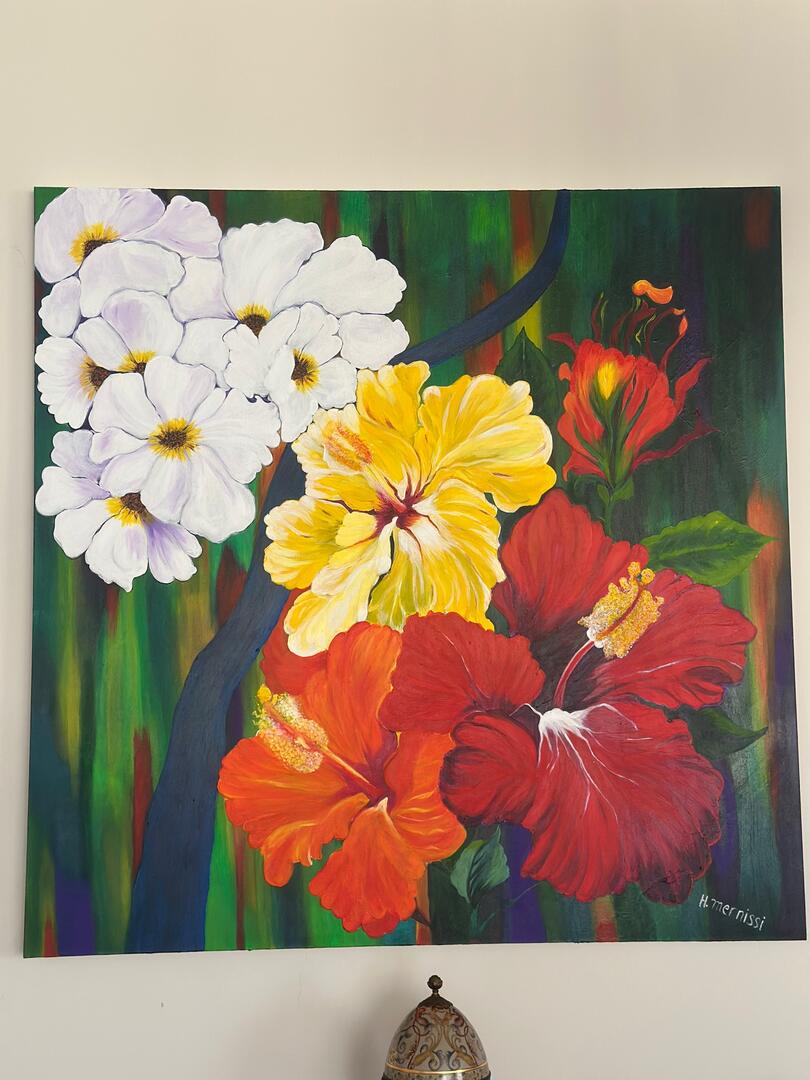
My Story with Art
We continue the journey of childhood and adolescence, that fragile passage where awareness begins to take shape, where one stands between obedience and self-assertion,
between accepting a world already defined, and quietly defending one’s own existence… one’s identity… one’s choices.
It was not an easy time.
I was stubborn, curious, and sometimes rebellious without knowing why.
My family, on the other hand, was protective, loving, and deeply responsible, perhaps afraid that I might lose my way.
It was between these two forces that art entered my life, not as a skill, but as a refuge.
It did not judge me.
It did not correct me.
It listened.
Art became my companion in moments of solitude,
a silent language that translated what I could not yet say.
It was never about fame,
never about competing with my brother,
who remained my first model and inspiration.
It was something alive.
A presence.
A quiet force that held me together,
and, at times, brought me back to life.
My first friendship was with the pencil.
Between the ages of six and ten, in primary school, I drew everything my eyes could hold. I copied my father’s drawings with fascination. I followed the lines of my brother Sidi Mohamed's paintings, Fez landmarks, Oum Kalthoum, King Mohammed V, and even Hercules. I found joy in the illustrations of old schoolbooks, especially a simple image I never forgot: a traditional plough pulled by a camel and a small donkey, from a book called Notre Ami le Livre.
I redrew the world as I saw it.
Not perfectly,
But sincerely.
And that was enough.
As I grew, drawing became more than play.
In middle school, it became a way for me to assert myself. A way of saying, I am here.
My teachers noticed. My classmates asked me to draw them. I found a particular joy in geography class, where I could transform maps into something alive. My teacher, Mr. T’Hiyfa, himself an artist, would look at my work with a long, silent admiration. He rarely spoke, but his smile and the marks he gave told me everything.
I was learning without realizing it.
Self-taught, yes.
But not alone.
My brother used to call me “the sponge.”
And I absorbed everything.
One day, my mother surprised me.
She brought me paints, brushes, and paper.
It was a simple gift.
But for me, it opened another world.
My first painting, really, from my own inspiration, was Oum Kalthoum.
My mother loved her voice, and I wanted to offer her something in return. That painting became more than a picture; it became part of our home. It was hung in the parlor, and every guest who entered would stop, look, and ask.
That was the first time I felt that art could live among people.
I discovered watercolor by accident. It resisted oil, blended with water, and demanded a different kind of patience. But I felt as if I had always known it.
Colors entered my life.
And never left.
I began painting everyone.
My mother.
My father.
My sister.
My brother’s beloved singers.
Soon, my father began to ask for more portraits of his friends, people I observed carefully before touching the paper: Si Mohamed Laabi, Abdelkrim, Rahmouni…
But one remained my favorite.
Zanbote, the milkman.
He carried in his face something of Churchill,
and something of Fats Domino.
A presence.
I enjoyed painting him as if I were capturing a story, not a man.
Each portrait became a small victory.
But also a confrontation.
If it was not right, I would start again.
I could not accept the approximation.
Art was teaching me discipline, without telling me.
But as my passion grew, so did my family’s concern.
My father did not see art as a path.
For him, education was the only secure road.
Art was a hobby.
Nothing more.
So I began to draw in secret.
Late hours.
Hidden moments.
A quiet resistance.
Not against my family,
But for myself.
Then life shifted.
After the age of fourteen, everything changed.
Responsibilities came early.
Losses came suddenly.
And art… faded into the background.
Not because I stopped loving it,
But because life demanded something else.
I told myself I would return to it.
One day.
That day came much later.
After my fifties.
After life had taken and given,
broken and rebuilt.
After the passing of my wife,
When silence returned in a different form.
It was my daughter who gently pushed me back toward painting.
At first, I did not know how to begin.
I felt like a stranger to my own hands.
But I drew anyway.
Not to produce.
Not to impress.
But simply to breathe.
This time, art returned differently.
It was no longer about form.
It was about meaning.
Sufism opened another door.
I found myself drawn to Arabic calligraphy, to the invisible geometry of words, to the poetry of Rumi, Mawlana, Hafez. The landscapes of North America, the stillness of the Northwest, and the quiet strength of the Pueblo all found their way onto my canvas.
I was no longer drawing what I saw.
I was drawing what I felt.
And I often asked myself:
Why did art leave me…
only to return again?
Today, I understand.
Nothing was lost.
Everything was unfolding.
There is a precision in life
as there is in painting.
A hidden composition.
And perhaps, just as we layer colors on a canvas,
God layers our lives
with the same care,
the same patience,
the same unseen mastery.
Keep exploring
Discover more stories from Morocco and beyond
Written by
Hamid Mernissi
I was born to travel the world. I am an anthropologist, a Sufi seeker and a student of life.
Comments
No comments yet. Be the first to share your thoughts!
Leave a comment