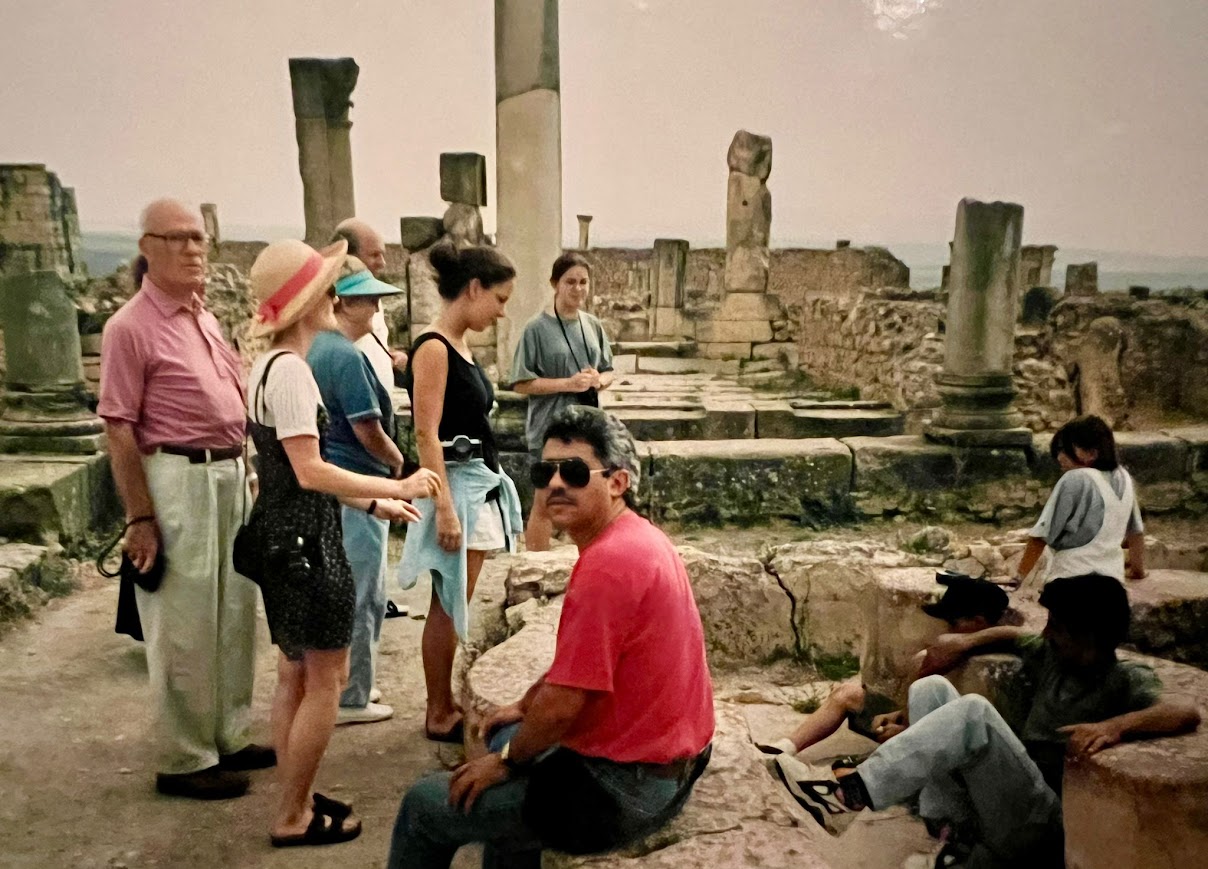
The Boy Who Never Left the Medina
There was a boy
Who walked the narrow veins of Fez?
as if they were drawn for him alone.
He did not hurry.
He absorbed.
Lavender in the wind.
Myrtle on the hillside.
Thyme crushed under small, determined feet.
Orange blossom whispering above stone walls.
He carried no map.
The Medina carried him.
He listened to cows breathing,
to donkeys arguing with the morning,
to roosters breaking the dark,
to wool and dung and steam rising from barns
like incense too honest to be perfumed.
He did not call it hardship.
He called it life.
There were shadows around him.
Strong shadows.
Maallam Driss, (father)
firm like carved cedar,
eyes measuring not with suspicion
but with expectation.
Hlima, (farm manager)
earth-handed, barn-scented,
laughing like someone who has wrestled life
and chosen love anyway.
Lalla, (Grandmother)
warmth folded into silence,
prayer without noise.
The boy loved them
with a devotion that needed no language.
To impress them
was not pressure.
It was joy.
He did not perform.
He reciprocated.
Then death entered
without knocking.
Twelve years old.
A door closed.
The boy almost blamed the sky.
Almost blamed the absence.
Almost blamed the one who left.
But grief does not ask permission.
It opens a window where walls used to be.
Through that window
He saw something terrifying:
Nothing stays.
Through that same window
He saw something greater:
Nothing disappears.
He cleaned barns in winter.
He went to school smelling of cows.
He carried responsibility like a coat
two sizes too large.
He did not complain.
He did not dramatize.
He stood.
He fought when necessary.
He hardened his shoulders.
He let Marx and philosophy dress his mind
like Armor borrowed from libraries.
But underneath,
always underneath,
the boy was tender.
Romantic.
Observant.
Listening to the silence between words.
He went atheist for a season.
He wrestled God like stubborn kin.
He doubted, rejected, and explored.
But warmth never fully left him.
Because religion had first come
not as a command
but as a sanctuary.
The M’ssid had taught him discipline.
The shrine had taught him wonder.
Structure and sky.
He left at nineteen.
But Bentato never left him.
Wherever he walked,
Spain, Africa, distant continents,
He compared the soil.
Compared light.
Compared olive trees.
No tree was ever quite the same.
Not because the world lacked beauty,
but because memory is geography carved into the gut.
He grew into a man
too quickly.
But the child did not retreat.
They began to speak to each other.
Sometimes they laughed
at the seriousness of adults.
At the worship of material things.
At the illusion of permanence.
They enjoyed what they had.
But placed nothing between them
except gratitude.
They did not fear death.
To them, death was only
another gate of the Medina
opening toward the hills.
“I enjoyed the alleys,”
The boy would say.
“Now let me see the flowers.”
He never wanted followers.
Even as a small guide
chased by police
through the labyrinth of Fez,
He did not say,
“Follow me.”
He said,
“Look there.”
Look at the woodwork.
Look at the arch.
Listen to the echo.
Smell the spice.
Notice the light.
He still says that.
Not to tourists now,
but to readers.
Look inside.
Look gently.
You are not alone.
He does not seek applause.
If one person
somewhere
closes his story
and feels less alone,
The boy smiles.
Not triumphant.
Not loud.
Just full.
He would not change a thing.
Not the barn.
Not the loss.
Not the anger.
Not the winter.
Not the hunger.
Not the exile.
Because fullness is not comfort.
Fullness is living without refusal.
And when his last breath comes,
He imagines no darkness.
Only a gate opening.
The Medina behind him,
familiar and loved.
The hills ahead,
unknown and fragrant.
He walks.
Not afraid.
Because the boy
who once roamed narrow streets
learned early
that nothing truly dies.
It transforms.
And so, he remains
not as memory,
not as nostalgia,
But as a compass.
The boy who never left.
Keep exploring
Discover more stories from Morocco and beyond
Written by
Hamid Mernissi
I was born to travel the world. I am an anthropologist, a Sufi seeker and a student of life.
Comments
No comments yet. Be the first to share your thoughts!
Leave a comment