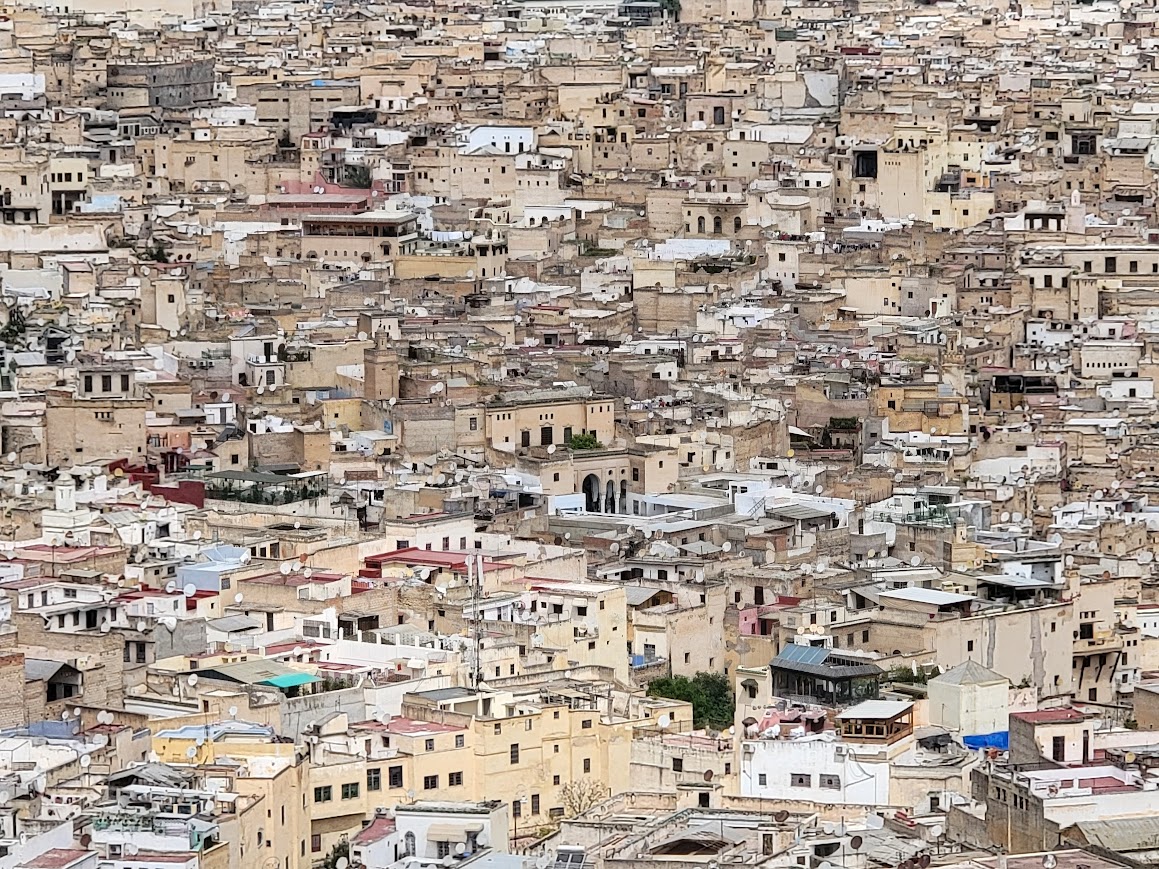
The Labyrinth That Raised Me
(poetic prose version)
We are speaking of a Medina that does not belong to time.
Inside its walls, centuries do not pass; they settle.
Stone leans on stone the way elders lean on memory. Doors have been opened and repaired so many times that the wood itself seems to remember the hands that touched it. Nothing is ever thrown away; it is reshaped, mended, reabsorbed. Recycling was never an idea. It was survival, instinct, continuity.
I did not know I was born twelve hundred years ago.
I only knew I was born into corridors that twisted like thoughts.
The Medina did not have streets. It was with veins.
You did not walk it. You entered it.
Sometimes you could step through the main door of a house and exit far away, closer to where you needed to be. We called those houses Kharraja, exits of trust.
No one stopped you. No one questioned you. The house knew. You knew. It was not intrusion; it was responsibility. A Kharraja was a sacred passage. Even as children playing hide-and-seek, we respected it. Morning crossings were acceptable. Afternoon rest was not to be disturbed.
That is how you learned without being told.
Respect was not taught in sentences. It was practiced in shortcuts.
Growing up in the Medina meant scanning light and shadow in a single glance. You measured the open alley and the blind turn before your foot touched stone. The map was not in your pocket. It was in your head.
It never occurred to me that I was learning orientation.
I was simply roaming.
Roaming was not wandering. It was a conversation.
With walls.
With fountains.
With echo.
With silence.
If you got lost in your own Medina, you were foolish. The labyrinth did not forgive ignorance. But if you listened, it opened.
The animated streets carried markets, noise, and the scent of leather and spice. The hidden alleys held coolness and secrets. The choice was always yours. Loud path or quiet vein. Monumental square or humble slope.
Choice.
That was the first freedom the Medina gave me.
And with freedom came measure.
You lived close to others without feeling crowded. You watched without staring. You listened without intruding. You learned to feel space even when space was narrow.
Quider was my neighbor. Same age. Same stubbornness.
Before we became friends, we had to collide.
Respect was negotiated with fists first, then with laughter.
He was built strong. I had Bentato in my bones. We discovered quickly that fighting was inefficient. Partnership was better.
After school we did not go home.
We expanded territory.
We moved from Swiqt Ben Safi to Nejjarine Square as if we were explorers charting unknown land. We studied the boy selling sweets near the shrine of Moulay Idriss. We traced supply lines back to Attarine. We counted coins in other children’s hands and measured which candies disappeared fastest.
We were nine.
But the Medina does not wait for adulthood.
It invites participation early.
Our mothers lent us fifty cents each. One dirham of capital felt like an empire. We built a small wooden box wired like a cage, our treasury of sweets. We arranged them by price, as experienced professionals.
Two weeks later, our coins multiplied.
Candy was temporary. Grits marinated in cinnamon were better.
For five cents, you could receive a portion cut fresh from the pan. The scent carried down the alley. The leftovers fed us.
Quider sold.
I guarded.
Then we reversed.
We expanded into other neighborhoods. We made allies and rivals. We learned which streets welcomed us and which demanded negotiation.
The Medina was teaching without a syllabus.
Outside its walls, in Bentato, the orchard waited.
Windfall apples gathered beneath trees. No scale, no weighing. Small piles formed by instinct. Five apples for five cents. Ten for ten.
We spread an old sackcloth at Ben Safi market and waited for buyers.
Then came prickly pears.
At dawn, with Hlima’s help, we harvested them, careful but never careful enough. Thorns lodged into skin. Fingers burned. But the coins accumulated.
By summer’s end, cedar-scented piggy banks held thirty dirhams each.
Thirty dirhams.
At nine, we bought tickets to the Al Ashshabine theatre to watch Hercules conquer impossible worlds.
We walked in proudly, coins earned, not gifted.
The Medina had not made us businessmen.
It had made us participants.
Sometimes I wonder.
Did the Medina wire my mind?
Or did my mind simply recognize its rhythm?
I do not know.
I only know that when I step into any city in the world, I still scan it first.
Where is the open path?
Where is the blind turn?
Where is the quiet vein?
Where is the animated square?
The Medina remains in my bones.
It existed before me.
It will remain after me.
I am simply one of its passages.
Keep exploring
Discover more stories from Morocco and beyond
Written by
Hamid Mernissi
I was born to travel the world. I am an anthropologist, a Sufi seeker and a student of life.
Comments
No comments yet. Be the first to share your thoughts!
Leave a comment