The Traditional Fassi Wedding: A Journey into Morocco’s Ancestral Rituals
The traditional Fassi wedding, especially in old Fez, was more than a ceremony. It was a family ritual, a celebration of lineage, and a carefully orchestrated sequence of events that honored ancestral customs dating back centuries. Every step carried symbolic meaning, weaving together devotion, joy, kinship, and community.
Here is an immersive look into how weddings were traditionally celebrated in Fez.
Choosing the Bride: A Family Affair
In old Fez, marriage began long before the couple met.
The groom’s mother played a central role, choosing a potential bride during family gatherings, through close friends, or via trusted neighbors. Often, the groom had no prior acquaintance with the bride; he only knew her through his mother’s and sisters’ descriptions. Even the idea of marriage usually came from the parents, not the young man himself.
“Ash-shwâr”: The First Visit
The groom’s mother, accompanied by respected older women (mstukbârât), visited the girl’s mother to propose the union.
If the family showed preliminary openness, the bride’s mother asked for time to consult her husband.
The father’s role was decisive: he discreetly inquired about the young man’s reputation, behavior, moral standing, family lineage, and financial stability.
“Kamâlat al-‘Atiyya”: Agreeing on Terms
Once both sides agreed, the men of the two families met to negotiate:
the dowry,
the gifts,
and the bridal trousseau. (el Mehouat)
When they reached mutual satisfaction, they set a date for the official engagement. Before this formal step, the groom’s mother visited the bride’s home with gifts, usually fine fabrics for dresses (tafâsil), as well as dates, henna, candles, and symbolic offerings of blessing.
The Engagement: Reading of the Fatiha
The two families gathered again, and a religious scholar recited the Fatiha, sealing the engagement.
They set the engagement period and agreed on the wedding date.
“At-Tafkira”: Gifts Throughout the Season
From the engagement until the wedding, the groom was expected to send regular gifts to the bride, especially during religious celebrations, a tradition expressing care, continuity, and respect. This must be a surprise. To remember the.
“Nhar al-Farsh”: Preparing the Marital Room
The bride’s mother visited the groom’s home to measure the bridal chamber.
It was the bride’s family who traditionally furnished the room, bedding, cushions, curtains, carpets, and the symbolic canopy known as “ad-dakhshûsha.”
“Nhar an-Naqîl”: Transporting the Bridal Furnishings
Days before the wedding, the bride’s trousseau was carried from her home to the groom’s house.
This delicate task was performed by the Zerzâyya, the trustworthy porters of Fez, accompanied by women from the bride’s family, who supervised the arrangement of the room.
The Ritual Baths (Taqbîba)
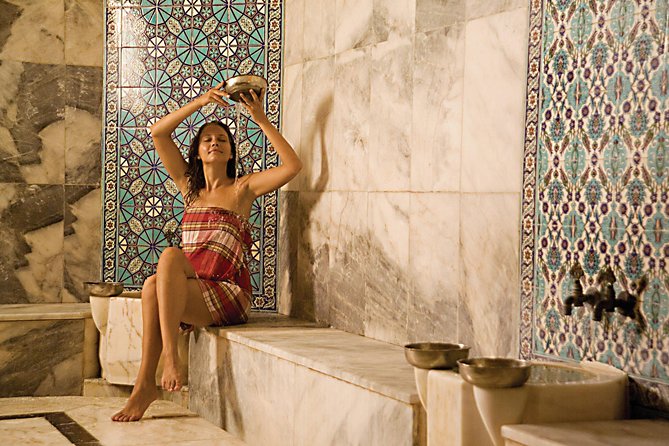
In the week leading up to the wedding, the bride visited the public hammam seven times, preparing spiritually and physically.
On the day of the Taqbîba, she was accompanied by relatives and friends, chanting blessings upon the Prophet as she bathed under the guidance of specialized women attendants known as at-tayyabât.
The Henna Night
Celebrations began in earnest with the Henna Night.
A professional henna artist (al-mu‘allma al-hennayya) adorned the bride’s hands and feet. After the henna dried, it was traditionally removed with a coin, a ritual gesture symbolizing prosperity.
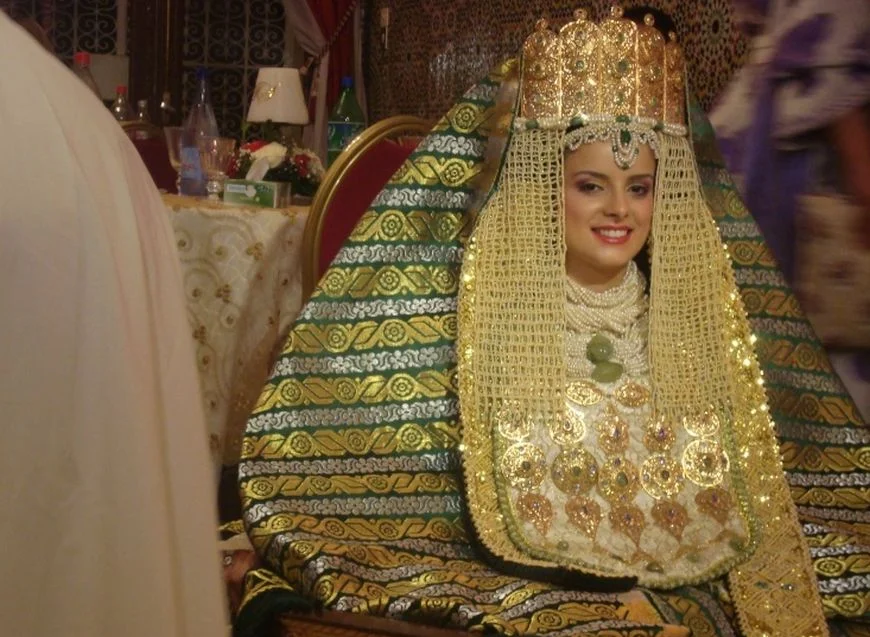
The following day, the bride’s relatives and friends held a party, followed by another evening featuring the famous Fassi niggâfât, who dressed the bride in traditional outfits:
The “Kebîra” ceremonial dress,
The “Jawhar” outfit,
The “Takchita”,
and the renowned Fassi wedding attire.
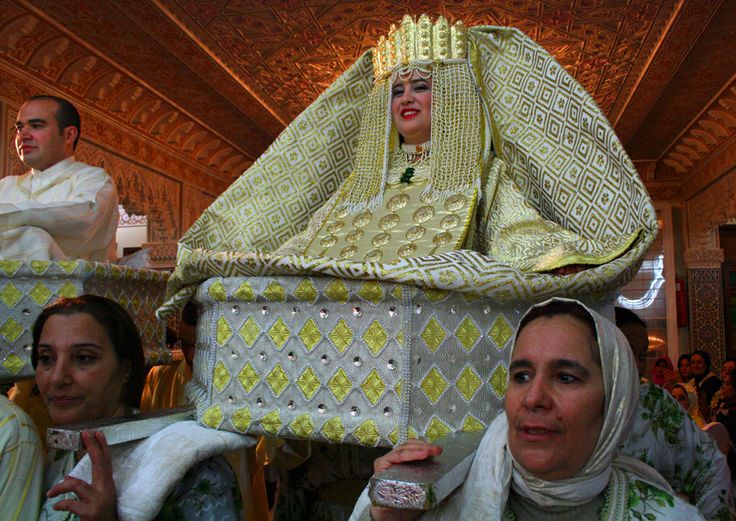
The bride was then lifted on the “mîda” (bridal chair) as women ululated, musicians played, and families celebrated late into the night.
The “Rahîn” Ceremony
A unique Fassi custom:
The bride sat upon a decorated platform surrounded by brocade cushions.
The main neggâfa began chanting:
“Al-‘arûsa marhûna…”
(“The bride is pledged…”)
Each line invoked a family member: father, mother, aunts, uncles, and when a name was mentioned, that person stepped forward, kissed the bride, and placed coins into a white scarf held by the nikkâfa.
This ceremony blended blessing, humor, tenderness, and family bonding.
Among the most famous neggâfât of Fez were Hajja Batoul and Hajja Maftaha.
Wedding Night (“Laylat ad-Dukhlâ”)
A great celebration took place at the bride’s home.
Guests departed late at night, leaving only close family to await the groom’s arrival.
Meanwhile, the groom held a parallel celebration before forming a festive procession, accompanied by musicians, relatives, and nikkâfât, to escort the bride.
Only women entered the marital home with her.
After she rested, the neggâfât dressed her in a final ceremonial outfit, veiled her face, and guided her to the bridal room, holding two loaves of bread, symbols of abundance and blessing.
The groom entered separately, unveiled himself at the door, and joined his bride in the dakhshûsha, the symbolic wedding alcove.
Dar Islane a visit to be exchanged between families.
“As-Sbûhî”: The Morning After
The next day, known as “Nhar Hall ar-Râs” (The Day of Unveiling), a large feast was held.
The bride’s mother arrived with breakfast for the newlyweds:
rice pudding with milk,
boiled eggs,
aromatic steamed buns (reyyûs m’bakhkharîn),
and pastries.
She also brought gifts for the groom’s mother and sisters, fine fabrics (tafâsil), as tradition required.
On the seventh day, the couple left the dakhshûsha to begin their everyday married life.
The groom’s mother then assessed the bride’s household skills, a customary rite known as “at-ta’wîl.”
A Living Heritage
The traditional Fassi wedding reflects a world of values:
respect,
hospitality,
family dignity,
artistry,
ritual beauty,
and communal involvement.
Though modern weddings have changed, the memory of these customs, the fragrances, songs, garments, and blessings, remains deeply woven into the soul of Fez. Somethings never change.
On the fourth day, the mother of the groom will prepare breakfast and bring it to the Dakhshusha. The bride must bow and go beneath her right leg, a sign of respect and submission for life. A bond and a vow that would never be broken. Then prepare a shade fish dish so she can prove to be a good cook. A fish dish in the Fassi way is one of the most complicated to prepare. Marital life always starts with tests, domination, and submission.
Keep exploring
Discover more stories from Morocco and beyond
Written by
Hamid Mernissi
I was born to travel the world. I am an anthropologist, a Sufi seeker and a student of life.
Comments
No comments yet. Be the first to share your thoughts!
Leave a comment